About Belper
Belper is a small, attractive market town, situated in the Derwent Valley, Derbyshire, 8 miles north of Derby. The river Derwent and the A6 trunk road, a former turnpike, run along the western edge of the town.
The first, North Mill, was started in 1776, completed in 1786 and destroyed by fire in 1803. It was replaced a year later by Jedediah's son and admired at that time by some, as the most beautiful and technologically advanced building of the era, mainly due to its fire proof structure, the warm air central heating and the breast shot water wheel.
There were 5 mills in Belper by 1792 and only North Mill remains out of the original ones. It is now the home of the Derwent Valley Visitors Centre, containing exhibitions illustrating the development of the factory community in the 18th and 19th centuries. On show are examples of Hargreave's Spinning Jenny, Arkwrights Water Frame and Crompton's Mule. There are also examples of stocking making machines and the ancient art of chevening - the decoration of stockings by hand. The visitors centre is open, nearly all year round, from Thursday to Sunday, from 1.00pm to 5.00pm. The stone archway over the road once connected North Mill to West Mill. Built around 1795 it also provided a defensive role, for along it's length are gun embrasures which protected the West Mill counting house. Much of the mill site was cleared in the 1960's.
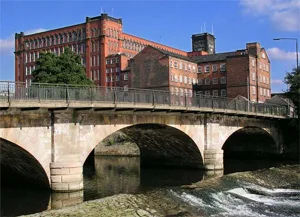 Image taken from www.derbyphotos.co.uk
 In 1912, a massive red brick, 7 storey East Mill was built, which dominates the town. It closed as a mill in the late 20th century and now houses a number of small industrial units, but still remains largely empty.
Below the mill complex, the River Derwent is spanned by a fine stone bridge of 1795, replacing the old one washed away in a flood. Here in a lovely natural setting the river makes a cresent shaped waterfall on its way down to the lower valley.
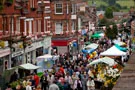
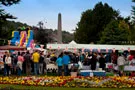
On the north side, are the well laid out River Gardens, an attractive place to escape the hustle and bustle of the busy town centre, which has a pedestrianized shopping street, leading to the old market place which is soon to have some restoration work carried out, with money provided, in part, by the Heritage Lottery Fund. It too is to be pedestrianized, with the existing tarmac being replaced by natural stone setts and gritstone paving slabs to the original design.
The Strutt family were great benefactors of the town for some 150 years, providing, employment, housing, education and even food from it's model farms, to its workforce. Many of the mill workers lived in Long Row, where the 3 storey houses are built of gritstone and the original cobbled paving remains. South Row also housed mill workers, it's 3 storeyed cottages partly built of brick.
The influnce of the Strutt family can still be seen in the town today. It's school, the Herbert Strutt school was built in 1909.
There are ample places of worship in the town but one of the oldest buildins is St John's Church, said to have been built by Edmund Crouchback, Earl of Lancaster, in the 13th century. It is a simple nave and chancel under a single roof on 5 ancient beams. It had a porch added in 1634 and a bell turret in 1699, and has undergone only minor restoration since. It's use as a church declined when St Peters Parish Church was erected in 1822-24, followed by Christ Church in 1849. It has been used as a school house in the past, and a meeting place for many local organizations.
George Brettle was also of some considerable influence in the town having established a hoisery business here which once employed hundreds of people. The George Brettle Warehouse, built in classical style in 1834, still survives in Church Street.
All the normal large stores are catered for and there are many fine inns in the town, including 2 Georgian ones in Bridge street, the Red Lion and the George and Dragon.
The railway makes an interesting feature in the town centre as it runs through a deep cutting, a mile long, that is crossed overhead by 10 bridges. This section of the line was built by George Stevenson in 1838 and at the time was considered by some, an engineering masterpiece.
Belper's population is now around 20,000 and growing. It is a popular and attractive place to live. New estates have been built up to accommodate its expansion. Belper is twinned with Pawtuchet in Rhode Island, USA, the link being Samuel Slater who was born in Belper, apprenticed to Jedediah Strutt and who became the father of the US cotton industry.
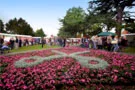
Belper holds it's annual Well Dressings in mid July.